"Short pantelleria lexicon"
"dammuso" indicates the house, the dwelling. Another name for the dammuso is "locu",
"locu", a Sicilian word, whose clearly Latin origin, locus, dates back to the period in which the Sicilians, subjects of the Eastern Empire, landed on Pantelleria following the Byzantine occupation. In ancient times, this last term, locu, indicated the house located in urbanized centers (Scauri, Tracino, Khamma), while the word dammuso indicated the country house.
There are two types of dammuso:
"rutta" stone, i.e. rough stone, and the thickness of the walls ranges from 1 to 2 metres.
with "tagghiata" stone, that is, with squared stone. The squared stone dammusi, whose walls are 40-90 cm thick, are found in the urban areas of Khamma, Tracino, Scauri etc. and have external plaster painted in pastel colors or simply whitewashed. In rural dammusi the thickness of the walls ranges from 1 to 2 metres.
When cut stone was used and lime was introduced, the thickness of the walls was reduced to 40 cm. and the stones walled in a single row were linked with lime and earth. The external walls, previously inclined, were built plumb, the height of the two types of dammuso is around 4 metres, excluding domes.
In the dammusi there are as many domes as there are rooms. Almost never plastered on the outside, they show the dark stones exposed without the joints being grouted with lime mortar or pozzolana.
There are few openings and small dimensions, to combat the cold and the heat, even if the dammuso is a thermo-regulated and acoustically protected construction due to its lava materials and the dimensions of the walls and the thickness of the vaults.
The dammuso, which is rectangular in shape, is usually accessed via a grassy path and will welcome you:
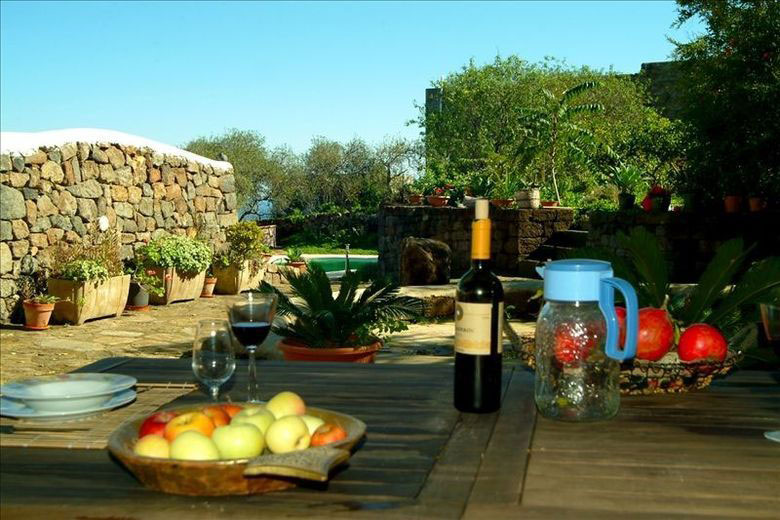
"u passiaturi, u pirterra", that is, a terrace with a balate or earthenware floor equipped with comfortable
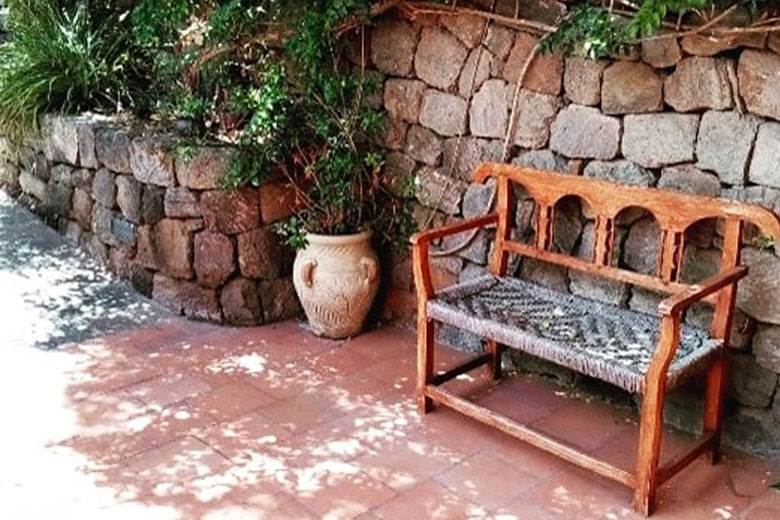
"ducchene" i.e. bricked stone seats with backrests
In the "Passiaturi" there is "a vucca da isterna"
On the terrace they overlook, most of the time,
"the eyes of arches", that is, two round arches of a bright room with three doors, two at the front and one to the left of those who enter and which leads into the kitchen, the heart of the house in the past, because the life of an entire working day took place and the family gathered around the table in the evening.
In the spacious kitchen, in front of the window, covered with majolica tiles and usually, "U furnu" for good "homemade bread". Generally the oven is located either next to the dammuso or inside a compartment, a kitchen accessory.
Next to the kitchen, where there is always a built-in wardrobe with or without a door ( u stipu a muro ) there is a warehouse ( u macaseno ) for storing malaga, blonde meat, pork, winter provisions and wine (the modern pantry).
The ceiling of the kitchen, warehouse and other rooms is vaulted.
There are different types of vault: barrel, gabled, cross vault, ribbed, with lunettes and real vault.
The barrel vault is the oldest and places the weight on the longitudinal masonry, it is slightly arched to allow rainwater to collect and flow into the cistern.
Variant of the barrel roof is the gable roof, typical of small country churches. These two types of vaults were built until the 17th century.
With the advent of lime, the domed, cross-shaped, ribbed and lunette roofing was created.
The actual vault, which unloads its weight along the entire perimeter of the building, is made up of four segments that converge in a single central point of the room.
The geometrically more complex lunette vault unloads its weight at the corners of the building. It is made up of several segments set on four arches, in their regular progression towards the center they form a rich composition of lines.
An important fact about a dammuso is the floor which in very ancient times was made of cooked earth measuring 20x20, in less ancient times it was made of majolica.
On the door, at the top, of the dammuso between the arch and the wooden plank, the "sardetta", a small closet for storing food or tools.
In the dammuso, in a hidden place, the man from Pantelleria stored his money and gold objects. We are in front of the "truvatura" a real safe. It was customary to keep the money even under a brick in the floor.
We leave the kitchen and enter the room from which we go, through the door, into the arches, that is, into the spacious and brightly lit room.
From the hall you also go into the
"Kammara" spacious and brightly lit environment.
"Arkova" is a small love nest where only the double bed is accommodated.
Bedroom with a round arch and a lower ceiling than the others, without a window
"cammarino", a second bedroom without a window
"cantaru", for nighttime needs there was no bathroom in the dammuso, during the day he went under a tree
Not far from the dammuso there are small buildings with dry stone walls and vaulted ceilings for the animals:
"U sarduni" for donkey or mule;
"U ghirbeci" for the goat;
"U zacchinu" for pork;
"U gaddrinaru" for the chickens
"A cunigghiera" for rabbits
Adjacent to the dammuso:
"U vagnanu" i.e. the vegetable garden
"The air" of circular shape, had in its center a pole to support a piece of wood which was tied to the blindfolded donkey for threshing
"U stinnituri" of rectangular shape encloses a space in rammed earth, protected on the longest side by a high dry stone wall and on the sides by two inclined walls.
The bunches of zibibbo are still arranged in the drying room to dry them in the sun to obtain the malaga, necessary for the production of passito di Pantelleria.
The bunches of zibibbo are also already immersed in the boiling solution of water and potash to obtain the blonde.
For this reason, near the drying rack there is a stove made of stones walled with taio (mud).
Next to the dammuso:
"U Jardinu" that is, the garden, cylindrical in shape and with dry stone walls. According to the notary D'Aietti, its paternity is Arab.
"Il palamento" a rectangular tub for pressing grapes
"The palaturi" who received the juice
In the country dammusi the pergola which decorated the façade, i.e. the façade of the house, adorned the façade with bunches of grapes made a fine display.
And always in the rural dammuso an old hoe, out of use, was walled up, taking care to leave the eyelet exposed, which was used to hold the halter of the parked donkey.
Important for its usefulness is "a Jsterna", the rainwater tank that served and still serves for all uses.
This cistern has stone walls and a vaulted roof, once less accentuated than that of the dammuso. The internal part is waterproofed with a mixture of tuff and lime up to a certain height. The cistern has an upper opening that allows you to draw rainwater, some also have a side opening which, in addition to allowing you to enter for cleaning, serves, together with the upper one, as an aeration system to keep the water fresh and oxygenated.
Beautiful dammusi and apartments in Pantelleria
Location of the Resort La casa dei fiori and map
You will breathe the atmosphere of home and you will be immersed in the luxuriant nature of Pantelleria
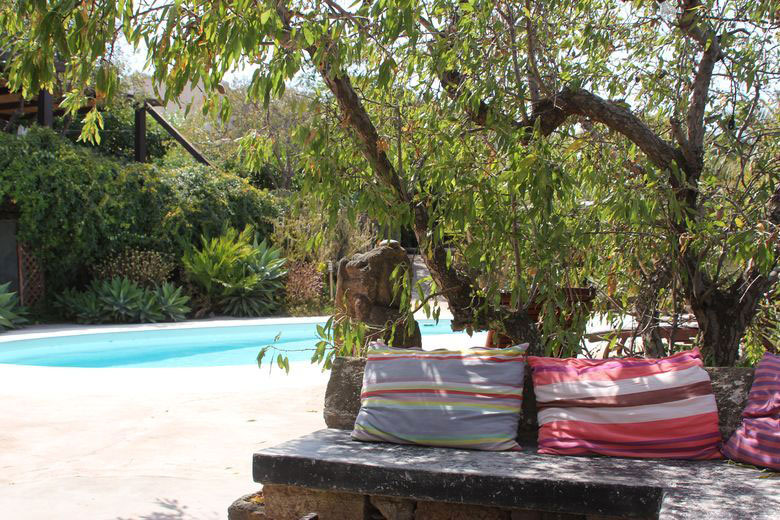
Composed of 4 independent dammusi, inserted in a charming and vast garden with swimming pool overlooking the sea, the Resort La casa dei fiori of Pantelleria is the ideal place for your holidays on the island of Pantelleria.